
Fern Relay Review
There is a profound sense of isolation that permeates the opening moments of Fern Relay, a co-op signal adventure that drops players into the heart of an unforgiving, rain-drenched wilderness. The premise is deceptively simple: re-establish a series of communication links across a sprawling, overgrown landscape. Yet, beneath this straightforward objective lies a meticulously crafted web of cooperative mechanics that demand constant, clear communication. As you and your partner navigate the dense, wet fern forest, the game slowly reveals itself not just as a puzzle-solving exercise, but as a rigorous test of teamwork. The atmosphere is thick with moisture and mystery, with every rustling frond and distant crackle of static adding to the immersive tension. It requires you to listen as much as you look, and to trust your partner as much as your own instincts.
The visual design of the forest is nothing short of breathtaking, capturing the damp, verdant essence of a dense bush environment. Raindrops bead on massive silver ferns, and the mud beneath your boots looks and sounds authentically treacherous. This is not merely window dressing; the environment actively impedes and influences your progress. Visibility is often limited by rolling fog or heavy downpours, forcing players to rely on the faint glow of their equipment and the crackling audio cues of their radios. The towering relay masts stand as stark, industrial monoliths against the organic chaos of the forest, serving as both your objective and your only beacon of hope.
Tuning the Frequencies
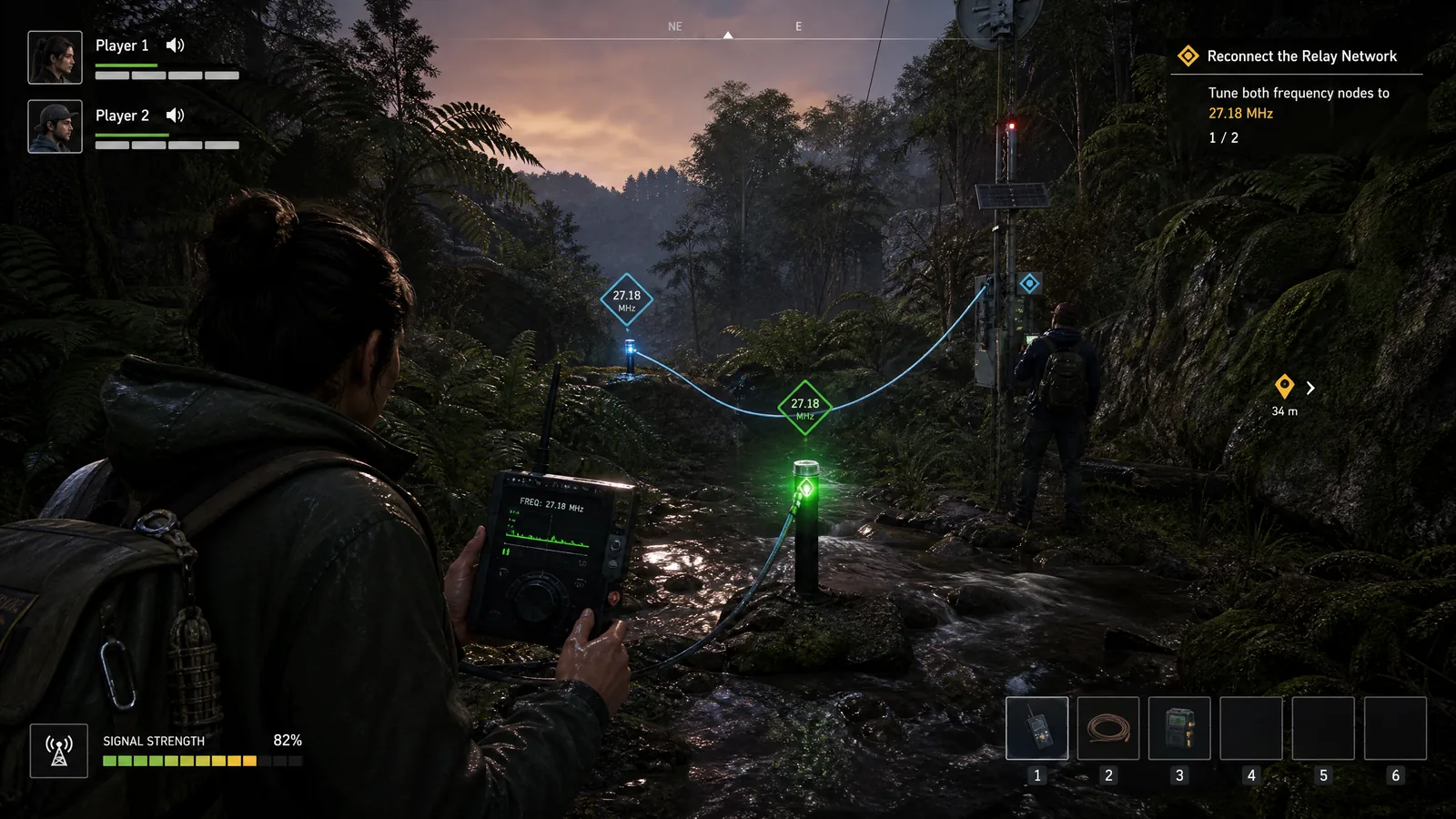
At the mechanical core of Fern Relay are the frequency puzzles, a series of intricate challenges that require one player to manipulate a signal tuner while the other adjusts the physical hardware on a relay mast. This asymmetry is where the game truly shines. The player on the ground must decipher complex readouts, identifying the correct amplitude and frequency required to establish a stable connection. Meanwhile, the player scaling the mast must physically align antennas, reroute power, and avoid environmental hazards. The genius of these puzzles lies in their interdependency; neither player has the complete picture. The ground operator might see that a frequency is spiking dangerously, but only the mast climber can see that a crucial wire has snapped and needs to be bypassed.
Communication, therefore, is not just a feature; it is the primary mechanic. Fern Relay does not provide helpful waypoints or on-screen prompts to guide your partner. If the tuner requires a three-degree shift to the left, you must articulate that clearly over the microphone. The game introduces deliberate interference, such as localised storms or magnetic anomalies, that can distort your voice chat or scramble your readouts. These moments of panic, where a perfectly laid plan unravels due to a sudden burst of static, are where the game is at its most thrilling. It forces players to develop a shared vocabulary, a shorthand of commands and confirmations that evolves naturally over the course of the campaign.
To prevent the experience from becoming stale, the game intelligently enforces role swapping at crucial junctures. You cannot simply designate one person as the perpetual climber and the other as the perpetual tuner. Certain relays require both players to ascend, while others split the party across vast chasms, forcing you to alternate responsibilities on the fly. This design choice ensures that both players appreciate the nuances and frustrations of each role. It also mitigates the 'alpha gamer' problem common in cooperative titles, where one player dictates the actions of the other. In Fern Relay, you are both equally vulnerable and equally essential. The transition between roles is seamless, and the game’s pacing benefits greatly from this constant shifting of perspective.
Going it Alone
While Fern Relay is undeniably designed from the ground up for two human players, the developers have included a solo mode where an AI companion assumes the other role. The solo companion behaviour is surprisingly robust, though it fundamentally alters the rhythm of the game. When playing alone, you can issue contextual commands using a radial menu, directing the AI to hold a position, adjust a dial, or climb to a specific node. The AI is highly competent at executing these discrete tasks, and it rarely makes unforced errors. However, the organic, chaotic communication that defines the multiplayer experience is entirely lost. It transforms a tense, cooperative thriller into a more methodical, solitary puzzle game. It is a functional alternative, but it lacks the emotional highs and lows of playing with a friend.
Accessibility is an area where the game deserves significant praise. Recognising that the frequency puzzles rely heavily on visual and auditory cues, the developers have implemented a comprehensive suite of accessibility options. Colour blindness filters are available, completely overhauling the user interface to ensure that critical information is never conveyed by colour alone. Motor control options allow for the toggling of rapid button presses and the adjustment of analogue stick deadzones, which is particularly helpful during the more physically demanding climbing sections. Furthermore, the audio cues that indicate signal strength can be supplemented with visual indicators and controller vibration, ensuring that deaf or hard-of-hearing players are not at a disadvantage.
Technical Pacing and Polish
The pacing of the adventure is generally excellent, carefully balancing moments of intense, brain-teasing coordination with quieter periods of traversal and exploration. However, the checkpointing system occasionally missteps. The game typically saves your progress after successfully activating a relay, which is logical. Yet, some of the more elaborate puzzle sequences can take upwards of twenty minutes to complete, and failing near the end—perhaps due to a missed jump or a critical miscommunication—forces you to restart the entire sequence. This can lead to frustration, particularly in the later stages where the complexity of the relays increases exponentially. A more granular checkpointing system would have alleviated some of this friction without compromising the game's challenge.
On the technical front, performance implications are a mixed bag. When the game is running smoothly, it is a visual and auditory treat. The wet fern forest is rendered with stunning detail, and the dynamic weather system is genuinely impressive. However, these visual flourishes come at a cost. On console, the game targets thirty frames per second, but heavy rainstorms or complex particle effects can cause noticeable dips. On PC, the experience is highly dependent on your hardware. While a high-end rig can maintain a flawless sixty frames per second at 4K resolution, mid-range systems may struggle with the dense foliage and volumetric fog. Players should be prepared for occasional stuttering, particularly when transitioning between large, open areas.
"The contrast between the natural world and the utilitarian technology you wield is a central theme, beautifully realised through the game's striking art direction."
Ultimately, Fern Relay is a triumphant entry into the cooperative puzzle genre, demanding a level of synchronisation and communication rarely seen in modern gaming. The satisfaction of tuning a signal through the static, of guiding a partner through a blinding storm, is unmatched. Its limitations—the occasionally punishing checkpoints and minor performance hiccups—are noticeable, but they do not significantly detract from the overall experience. The solo mode, while functional, is merely a shadow of the true, cooperative vision. This is a game built for two people willing to talk, listen, and occasionally yell at each other in the pouring rain. For those seeking a substantive, challenging, and incredibly rewarding cooperative adventure, this wet fern forest is well worth getting lost in.