
Review: Kāpiti Grid
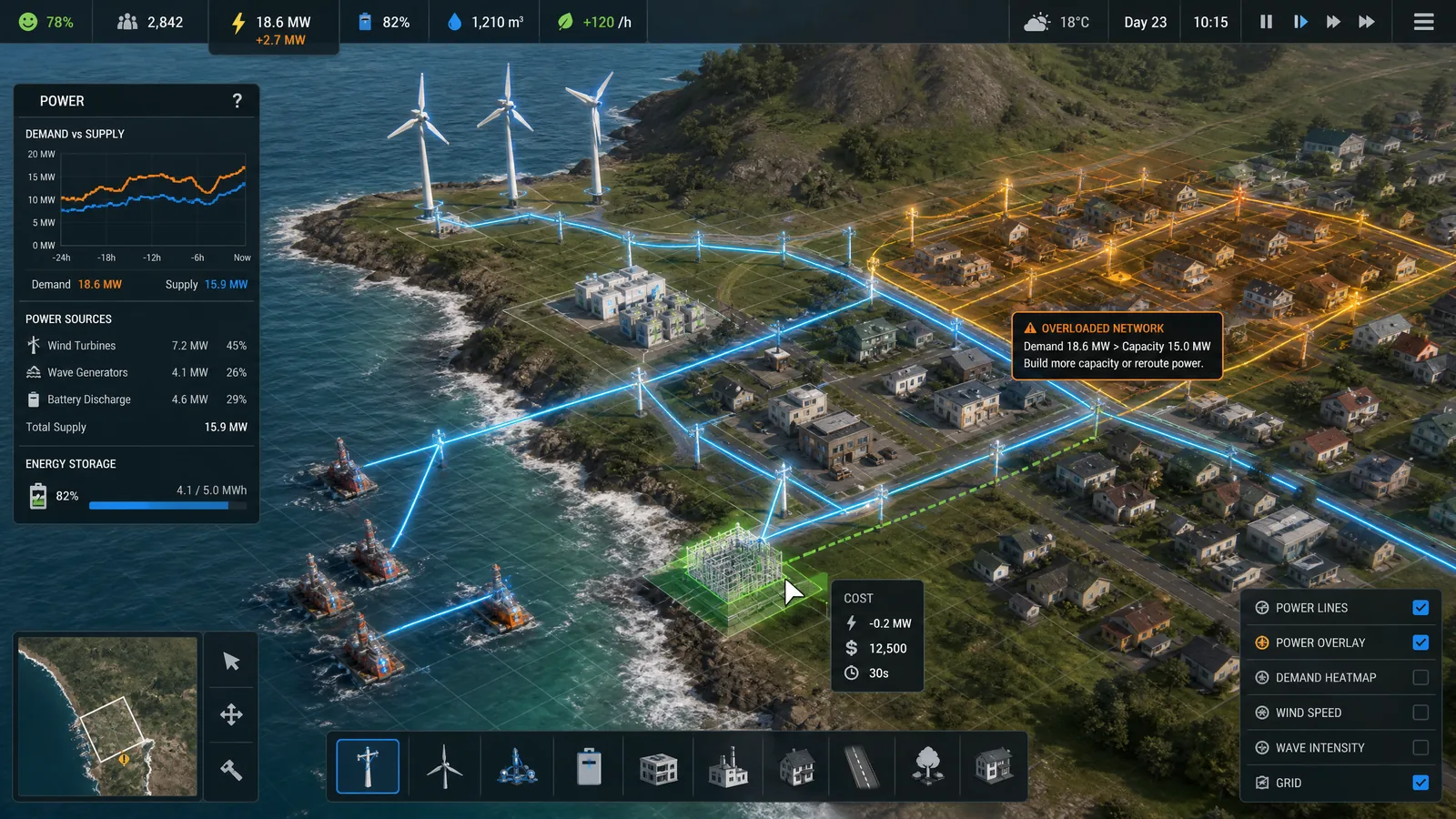
The city-building genre has long been fascinated with the macro-management of urban sprawl, yet few titles distil the tension of infrastructural survival quite like Kāpiti Grid. Set against a beautifully rendered isometric shoreline that evokes the rugged, windswept coasts of Aotearoa New Zealand, this coastal energy city-builder tasks players with a uniquely modern challenge: constructing a thriving town while meticulously managing a renewable energy network. You are not merely zoning residential blocks; you are architecting a complex web of wind turbines, wave energy converters, and massive battery storage facilities. The isometric perspective offers a god-like view of your burgeoning metropolis, allowing you to watch the waves crash against sea walls and wind turbines spin in harmony with the weather. It is a visually arresting experience, but beneath the tranquil surface lies a deeply demanding simulation that will test even the most seasoned logistical minds.
The core gameplay loop revolves around the intricate dance of supply and demand. Unlike traditional city-builders where power is a secondary concern, here, energy is the lifeblood of your entire operation. The build tools provided are robust and intuitive, allowing players to seamlessly snap transmission lines across challenging coastal topography. Laying down a new residential subdivision requires careful consideration of the grid's current capacity. Every new home and industrial facility draws heavily on your reserves, forcing you to constantly expand your renewable infrastructure. The tactile satisfaction of connecting a newly constructed offshore wave farm to your mainland grid is immensely rewarding. However, the game pulls no punches. Reckless expansion without adequate infrastructure planning will swiftly lead to rolling blackouts and a plummeting approval rating from your citizens.
Mastering the Elements
Where Kāpiti Grid truly distinguishes itself is in its sophisticated implementation of weather variability and demand forecasting. The coastal environment is notoriously fickle, and the game models this with unforgiving accuracy. A roaring southerly storm might send your wind turbines into overdrive, generating a massive surplus of electricity, while a calm, sunless week can leave your grid starving for input. Players must learn to read the meteorological forecasts provided by the in-game weather centre, adjusting their strategies days in advance. Demand forecasting becomes an essential skill; understanding the diurnal peaks and troughs of your citizens' energy consumption allows you to prepare for the inevitable evening surge. This predictive gameplay elevates the experience from a simple reactive builder to a proactive puzzle of resource management.
Managing these fluctuations inevitably leads to the challenge of grid overloads and the critical role of battery storage. When the wind is howling and the waves are crashing, your generation capacity can easily exceed immediate demand. Without sufficient battery grid connections, this precious surplus is wasted, or worse, can cause catastrophic surges that damage your infrastructure. Constructing and upgrading battery arrays is a massive capital investment, but it is the only way to ensure stability during lean periods. You find yourself micromanaging industrial output, perhaps temporarily shutting down a high-consumption factory to keep the hospital running. This granular level of control is deeply engaging, forcing difficult triage decisions when the grid is pushed to its limits.
The citizens of your coastal town are a demanding populace with complex needs. As your settlement evolves into a bustling coastal hub, the expectations of your residents rise accordingly. They demand not only a reliable power supply but also affordable electricity rates. Balancing the massive infrastructure costs of your renewable network against the economic realities of your citizens is a constant struggle. If you raise energy prices too high to fund a new wave farm, you risk stifling economic growth. Conversely, if you keep prices artificially low, you will lack the capital to expand the grid. The game models these socio-economic dynamics brilliantly, ensuring every infrastructural decision impacts the prosperity of your town.
Campaigns and Coastal Challenges
The campaign scenarios in Kāpiti Grid offer a masterclass in progressive difficulty and thematic storytelling. Rather than a simple sandbox mode, the campaign guides players through increasingly complex coastal environments. One scenario might task you with revitalising a decaying industrial port town with failing legacy infrastructure, while another challenges you to build a pristine eco-resort on a remote island. Each scenario introduces new variables and constraints, forcing you to adapt your strategies. The pacing is excellent, slowly introducing complex mechanics of demand forecasting and advanced grid management without overwhelming the player. Completing a gruelling scenario where you narrowly avoid a total grid collapse during a freak weather event is genuinely exhilarating.
The tension of watching your battery reserves slowly drain during a prolonged period of calm weather is palpable, transforming a tranquil city-builder into a gripping test of foresight and resource management.
Navigating the sheer volume of data required to manage a modern power grid could easily become a logistical nightmare, but Kāpiti Grid excels in its interface clarity. The UI is clean, minimalist, and highly functional, presenting complex information in an easily digestible format. Colour-coded overlays allow you to instantly identify stressed transmission lines, while detailed graphs track your historical energy generation and consumption. The controls are responsive, ensuring that players spend their time solving infrastructural puzzles rather than wrestling with clunky menus. The ability to pause the simulation and meticulously plan out a massive grid expansion is a welcome feature, providing a necessary breather during moments of high stress.
From a technical standpoint, the performance implications of simulating such a complex system are handled with impressive finesse. Even when your coastal metropolis has expanded to fill the entire map, with thousands of citizens and hundreds of energy nodes interacting simultaneously, the game maintains a stable frame rate. The visual representation of the grid—with energy pulsing along transmission lines—is aesthetically pleasing and functionally informative. The sound design further enhances the experience, with ambient noise of crashing waves providing a constant auditory reminder of the forces you are attempting to harness.
Final Verdict
Despite its many triumphs, Kāpiti Grid is not without its limitations. The sheer complexity of the simulation can be daunting for newcomers, and the initial learning curve remains steep. Furthermore, while the focus on renewable energy management is incredibly detailed, other aspects of city-building, such as traffic management, feel somewhat underdeveloped by comparison. These secondary systems serve primarily as additional energy sinks rather than fully fleshed-out mechanics. However, these are minor quibbles in what is otherwise a tightly focused and brilliantly executed simulation.
Ultimately, Kāpiti Grid is a triumph of the coastal energy city-builder genre, earning a highly respectable 8.5/10. It is a game that demands patience, foresight, and a willingness to engage with interlocking systems. It captures the modern zeitgeist of renewable energy transition, wrapping it in a visually stunning and deeply satisfying gameplay loop. For players who relish the challenge of optimising supply chains, analysing data, and battling unpredictable forces of nature, this title is an absolute must-play. It suits the analytical mind, the patient planner, and anyone who has ever wondered about the intricate web of infrastructure connecting a wind turbine to their living room.