
Red Harbour Protocol: A Masterclass in Stealth Tactics
The turn-based tactical genre has seen a resurgence in recent years, but few titles have managed to balance meticulous planning with the sheer tension of execution quite like Red Harbour Protocol. Dropping players into the rain-slicked boots of a clandestine three-operative squad, the game trades the sprawling battlefields of traditional strategy for the claustrophobic confines of a meticulously detailed container yard. It is a game where every action point is a precious commodity, and where the geometry of a single shipping crate can mean the difference between a flawless extraction and a catastrophic failure. With its unwavering commitment to stealth-first tactics and a punishing yet deeply rewarding difficulty curve, Red Harbour Protocol establishes itself as a formidable new entry in the genre, earning a well-deserved 8.7 out of 10.
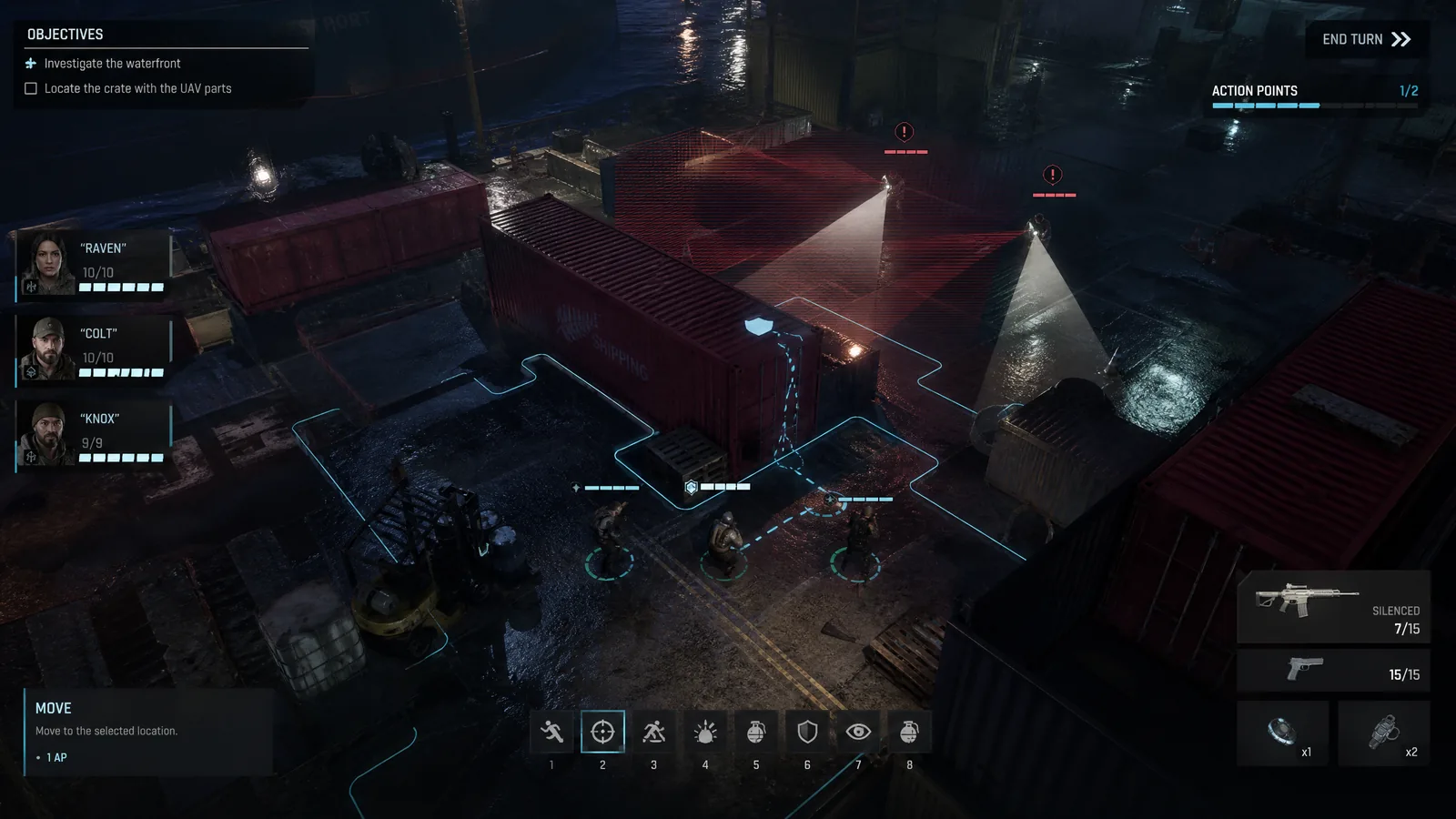
At its core, Red Harbour Protocol is a game about information asymmetry. Before a single shot is fired—and indeed, firing a shot is often a last resort—players must spend considerable time analysing the environment. The action-point HUD is cleanly integrated, providing immediate clarity on movement ranges, ability costs, and the all-important line of sight. The game’s vision mechanics are particularly noteworthy; enemy patrol cones are clearly demarcated, but they are not static. Guards react to sound, shadows, and the absence of their comrades, meaning that the stealth mechanics feel organic rather than rigid. You are not simply avoiding red zones on a grid; you are outsmarting an AI that actively hunts for anomalies within its patrol routes.
The cover geometry is where the tactical depth truly shines. Unlike games that rely on a binary system of full or half cover, Red Harbour Protocol introduces a nuanced approach to concealment. A rusted container might offer full protection from a sniper on a gantry, but it leaves you exposed to a flanking manoeuvre from a ground-level patrol. The three operatives at your disposal must synergise their positioning to maintain overwatch while advancing. The spatial puzzle of moving your squad through a maze of interlocking sightlines requires patience and a deep understanding of the environment. It is a system that punishes recklessness but generously rewards those who take the time to map out their turns.
Synergy and Squad Dynamics
Your squad comprises three distinct operatives, each bringing a specialised skill set that is vital for navigating the game’s complex scenarios. Rather than relying on generic character classes, the abilities are highly specific and designed to interact with the environment and each other. One operative might excel in electronic warfare, capable of temporarily disabling security cameras or manipulating automated loading cranes to create new paths. Another might specialise in silent takedowns and unparalleled mobility, utilising grappling hooks to secure high ground. The third often acts as the anchor, providing essential crowd control or vital distractions when a plan inevitably goes awry.
The brilliance of the ability system lies in its restraint. Abilities operate on strict cooldowns and often require a significant investment of action points, forcing players to make difficult choices. Do you use your hacker’s turn to blind a camera, allowing the infiltrator to advance, or do you save those points to establish a defensive perimeter in case a patrol deviates from its expected route? This constant resource management ensures that pacing remains tight and every decision feels impactful. The synergy between the operatives is not just encouraged; it is absolutely mandatory for surviving the game’s later stages.
The spatial puzzle of moving your squad through a maze of interlocking sightlines requires patience and a deep understanding of the environment. It is a system that punishes recklessness but generously rewards those who take the time to map out their turns.
Difficulty in Red Harbour Protocol is unapologetically steep, but it rarely feels unfair. The AI is sharp, aggressive, and highly responsive to player actions. If you leave a body in a poorly lit corner, a passing guard might not notice it immediately, but a sweeping flashlight beam will trigger a facility-wide alert. Once an alarm is raised, the game shifts from a methodical stealth puzzle to a desperate fight for survival. The enemy forces are well-equipped and coordinate effectively to flush your operatives out of cover. While the game provides the tools to survive a firefight, it makes it abundantly clear that open combat is a failure state of your stealth strategy, not an alternative playstyle.
Mission Variety and Performance
Mission variety is a strong suit, preventing the core loop from becoming stale. While the container yard serves as the foundational backdrop, the objectives within these environments are diverse. One mission might require the extraction of a high-value target from a heavily fortified administrative building, demanding a slow, methodical infiltration. Another might task your squad with planting tracking devices on specific shipping crates within a strict turn limit, forcing a more aggressive and risky approach. The varying objectives constantly challenge players to adapt their tactics and re-evaluate the utility of their operatives’ abilities.
Controls are intuitive, translating the complex tactical decisions into seamless inputs. Whether playing with a mouse and keyboard or a controller, navigating the grid, selecting abilities, and confirming actions feels responsive and precise. The user interface provides a wealth of information without cluttering the screen, ensuring that players can focus on the tactical situation rather than wrestling with menus. This clarity is essential in a game where a single misclick could compromise an entire mission.
From a technical standpoint, Red Harbour Protocol performs admirably. The environments are richly detailed, with dynamic lighting and weather effects that not only enhance the atmosphere but also play a mechanical role in the stealth system. Rain can muffle footsteps, while lightning flashes might momentarily reveal a hidden operative. The game maintains a stable frame rate even during complex turns involving multiple AI calculations and overlapping visual effects. However, there are occasional pathfinding quirks where an operative might take an unexpected route to a destination, briefly exposing themselves to danger. While rare, these moments can be frustrating in a game that demands absolute precision.
Final Verdict
Despite these minor technical blemishes, the overall experience is incredibly cohesive. Red Harbour Protocol knows exactly what kind of game it wants to be and executes its vision with ruthless efficiency. It is a game designed for players who relish the planning phase as much as the execution, those who find satisfaction in a perfectly orchestrated turn where every action point is spent with purpose. The limitations of the game—its punishing difficulty and the sheer concentration it demands—will undoubtedly alienate players looking for a more casual tactical experience. However, for its target audience, these are not flaws but features.
In conclusion, Red Harbour Protocol is a standout title in the turn-based squad tactics genre. Its unwavering focus on stealth, combined with intricate cover geometry and demanding AI, creates an experience that is both intellectually stimulating and incredibly tense. It asks a lot of its players, demanding patience, foresight, and a willingness to learn from failure. For those willing to put in the effort, it offers one of the most rewarding tactical puzzles in recent memory. It is a masterful execution of a challenging concept, and a must-play for anyone who appreciates the art of the silent approach.